Monday, October 24, 2011

Harvest Monday - October 24th

I've pulled out most of my summer plants - all but one of the tomatoes, the melon, the beans (which never really produced anyway). All that's left as I turn things over to fall crops are:

the lovely bell-pepper shaped, small tomatoes of unknown variety. I love them and am saving seed, which I'll happily share. Here are 20 tomatoes, weighing in at about a pound total. They are quite meaty for a tomato of this size. They got good reviews in my office tomato tasting (I don't like the flavor of fresh tomatoes). I love them dried.

I got 2 lb 3 oz of eggplants off the two plants and they are still producing like mad. The variety is Kyoto, purchased as seedlings. I will try to save seed from them as well.


2 lb 5 oz of Pool Ball summer squash. I'm pretty sure this is a hybrid but I'm saving seed anyway to see if I can craft an open pollinated version. I love this squash and will grow it again if I can. It's a world away from zukes or yellow crooknecks. Delicious and smooth, not at all watery.


I used some of the squash, a sundried tomato sausage, and a can of my own chopped tomatoes with garlic, herbs, and wine, to make this for dinner. It was divine.


Last, but not least, I've been enjoying all the visitors to my garden. Most of my neighbors (my lot is very urban) employ pest control companies. I like to think of my yard as a haven for any bugs that make it out safely.


Monday, August 29, 2011

Harvest Monday August 29th

I've been on vacation. My fabulous and generous sister took me to Oregon to the Shakespeare festival. We had an excellent time and saw many plays and ate delicious food, but that's a story for another venue. Pertinent to the garden is the fact that I wasn't home to harvest much and haven't been online to post.

Matt harvested a melon while I was gone and dutifully weighed it. When I got back home, there was a lot to pick, both tomatoes and cantaloupes. Some things had gone a little past their best, and were fed to the appreciative rabbits. Here is what was left:

These are the huge Sunset's Red Horizon tomatoes. Impressive, but I don't think I'll grow them again. Too big for me. It seems to give them more time to split, or be eaten by pests or sag onto the ground and rot. I have seeds, if anyone else is game. They've got great flavor and seem to be good for either sauces or slicing onto sandwiches. Just not my type, is all.


Here is a mix of smaller tomatoes.


This is the melon that ripen in perfect time to bring on our trip. I was very proud to bring something I'd grown myself. The flavor was divine.


Our little rental had a garden patio with a cute little bistro set. Here is breakfast the first morning: tea and melon and (not pictured) yummy biscotti I'd made with some dried peaches from the farmer's market.


melons: 14 lb 5 oz

tomatoes: 6 lb 1 oz


Monday, August 8, 2011

Harvest Monday August 8

This week's most exciting harvest was grapes! I've never grown grapes before (among so many other things). I planted Cayuga, Autumn Royal, Thompson Seedless, and an unnamed black wine grape. Only the Cayuga produced this year, which is more than I expected for such young vines.


They are yummy, but not seedless. This makes me realize how spoiled I am.


Another item of interest: I love the poolball (or is it 8 Ball?) squash I've been growing, much more than any other summer squash I've had. So, naturally, I let a couple of fruits alone to mature. They are huge now. I picked this one to see if the seeds are ready. Since allowing them to pass softball size, the plant had not been producing any more new fruits. Now that they are large and hard-skinned, the plants have started to flower again. The odd thing is, the new fruits are bright yellow, like crookneck squash, with dark green rims around the blossom and stem ends. Previous fruits had been a light green. Very strange.


Anyway, I didn't count the weight of the large squash, since I'm not planning to eat it, but I will count the weight of the dried seed. I've decided seed-weight is fair, since most of my garden costs come from seed purchases.


This week's totals:
7 oz squash
14 oz grapes
1 lb 1 oz tomatoes
4 oz eggplant


Yearly totals:
2 lb 14 oz greens
60 lb oranges
13.5 oz kumquats
13 lb cherries
14.5 oz radish pods
8 oz peas
9 lb 9 oz tomatoes
11 lb 12 oz squash
14 oz garlic
4 lb 1 oz new potatoes
2 oz herbs
2.5 oz onions
1 lb 5 oz ornamental plums
16 lb cultivated plums
4 lb elderberries
14 oz grapes
1 lb 1 oz eggplant


Don't let anyone dismiss your attempts at gardening. If I can do it, without prior experience, capital, chemical inputs, or much physical effort, you certainly have an excellent chance. To see some really impressive harvests, visit Daphne's Dandelions


Saturday, August 6, 2011

Winemaking adventures: Racking

New wine spends a week or two in the primary fermenter (bucket, on the home winemaking scale of production). During this time, fermentation is fast and furious and you can hear the contents fizzing like a newly opened can of soda. If you are making wine using fruit or grapes as opposed to juice, this is when the yeast is eking out every possible bit of flavor and sugar out of the solids. When fermentation dies down somewhat, the remains of the fruit can be removed and the wine is transferred into a secondary fermenter (glass carboy, for many of us) to finish fermenting. Primary fermentation can handle exposure to air because the yeast is going strong. Secondary fermentation limits the exposure to air, or you'd end up with vinegar.

Here's how this segment goes:

At the beginning of this batch, there was so much fruit in the bucket, I couldn't fit as much water and sugar as I needed to for the recipe. In fact, I had to take out some of the juice after the first day because the wine was bubbling out over the top of the bucket. Now, look how little is left of the fruit in that white mesh bag. The yeast took that fruit apart with relatively little waste. I have it in a colander over a bowl to drain as much liquid out as possible. The soda bottle on the left holds the juice I removed on the second day. The wine bottle holds the remainder of the sugar-water syrup that did not fit in with the fruit in the first place. With the fruit removed, there is plenty of room for both.

Since I added more sugars in the form of the sugar syrup and the unfermented juice, I let the wine stay in the bucket, covered with a dishcloth, for another couple of days until the fermentation died down a little bit again.

Then, I siphoned the wine out of the bucket, into the carboy. It's much better to siphon than pour because a lot of the solids that the yeast pulled out of the fruit settle to the bottom of the bucket (and later, will continue to settle out in the carboy as well). Racking the wine off these lees will help the flavor; leaving it on the lees can cause it to taste "off". In addition to solids from the original fruit, the husks of dead yeast cells also settle out. You don't want your wine to taste like dead yeast.

The easiest way I find to start the siphon is to hold the tubing with both ends up and fill it with water. Then I put my thumb over one end and lower it into the container I'm filling and the other end into the wine. When I let the pressure off the lowered end, it runs just fine.


I also racked the cherry wine, because it had dropped a lot of sediment as well. I made this wine with fresh cherries, which I mashed and dumped into the mesh bag, pits and all. When the primary fermentation was over, there was little left in the bag but skins and pits, so there are a lot of fruit solids in this wine which will need to settle out.
The frustrating part is how much wine is lost when there is a lot of settling like this. I had to stop about three inches from the bottom of the carboy, as the siphon was starting to pick up sediment. There are a couple of options to make up the difference when you rack wine. You can either top off with water, or top of with another wine that is similar to the one you are making. I used half water and half merlot.
Now that the wines are racked, I put the airlocks back on and they are back in the hall closet, working their magic in secret.

Monday, August 1, 2011

Harvest Monday August 1

This week was moderately productive, but mostly with summer standbys, tomatoes and squash. I am waiting for my Sunset's Red Horizon tomatoes to ripen. They are enormous, but still green. I decided to let a couple squash fruits to mature so that I can save seed (ok, they got to big to pick and I didn't cut them off), so suddenly my squash vines are not producing any new fruits. Male flowers, but no female ones. Hopefully they won't give up on me completely.

The exciting harvest for the week: the first eggplants! These came from seedlings I bought at OSH, a variety called Kyoto. It produces small fruits on lovely purple-veined leaves.

Hunting up eggplant recipes, since I am a newbie to the vegetable, I found eggplant fries. I followed the recipe loosely.


Flour, garlic powder, onion powder, cayenne, seasoned salt, and freshly ground black pepper.


Skin the eggplants, then slice into fry-shapes, according to your preferences. I like thin fries.


Toss with the flour mixture. This is important - too little flour coating and the fries will end up shriveled and limp. If I did this again, I might go with the traditional egg-and-flour coating. Still, if you get a nice thick coat, they do come out crispy and then you don't have to worry about the egg at all.


Into the oil! (We really shouldn't have a deep fryer. We eat enough bad things without it. But fried food sure is good.)


These were the first fries out, with not enough flour on them. They are all wimpy looking and were not crisp and delicious. Later ones were better but my fingers were too greasy for the camera. Eggplant fries are not as crisp or sturdy as potato fries. They do, however, have lovely creamy centers, since the eggplant inside gets soft and lucious. It was fun for an experiment, but I probably will use my eggplants for something else (healthier) in the future.


This week's harvest


1 lb 12 oz tomatoes
1 lb 3 oz squash
13 oz eggplant

Friday, July 29, 2011

Wine making adventure: mostly plum

Someday, I shall have enough fresh fruit of one kind to make a single-fruit wine. Until then, I make "mostly x" wines. In the hall closet I have mostly apple, mostly cherry, and mostly orange. This time, I had 18 pounds of plums picked from my own tree (one of those dark purple ornamnetal plums) and from a tree on my family's rental property. I also had 6 pounds of elderberries foraged along the riverbank. I had these all chopped up and frozen in gallon ziplock bags, as it wasn't quite enough fruit for a 5 gallon run. I like my fruit wines very fruit-forward, although not very sweet. Some winemaking sources say that a subtler, grape-wine-like wine can be made with other fruits if the fruit-to-water ratio is low. I don't want my fruit wines to taste like grapes, I like them to taste like fruit. I planted grape vines this year for when I want grape wines.

Anyway, the final contribution to my wine was made by my friend Gloria, who bought me a flat of delicious cling peaches. I used 3 pounds of the peaches to round out my wine. Here are the frozen plums and elderberries ready to go, just so you get the idea of how much fruit is required for a 5 gallon batch.


Different fruits vary widely in acids, tannins, and sugars. When I mix fruits in a single batch of wine, I break it down as if I'm making individual gallons when I'm hunting up recipes. There are some very good winemaking books. The Way to Make Wine by Sheridan Warrick and The Home Winemaker's Companion by Gene Spaziani are good ones, particularly if you want to make grape wines. They don't take fruit wines very seriously, but they give a lot of information about the technical process. They can also make winemaking seem intimidating. That is why I also like The Joy of Home Winemaking by Terry Garey. She really takes the intimidation out and also treats fruit wines as a valid beverage in their own right, not as if they are a poor man's alternative to good grapes.


Of course, practically speaking, fruit wines are my alternative to wine grapes. Brew shops sell fresh, frozen, and concentrate wine grapes, but it is expensive, particularly in 5 gallon batches. In summer and fall, a lot of people give fruit away because they have so much.


So, once I know what kind and how much fruit I have, I turn to my favorite online winemaking recipe source, Jack Keller. He can be relied upon to have a recipe for just about any crazy fruit you may have. He had several for plums, elderberries, and peaches. I chose a recipe for plum wine, which called for 6 lb of fruit, a recipe for peach wine which called for 1 lb of peaches, and split the difference between his two recipes for elderberry wine, one calling for 3 lb fruit, one calling for 10. Essentially, I pretended I was making 3 gallons of plum wine, 1 of peach and 1 of elderberry. Why? Well, the plum wine called for added tannin, but the peach and elderberry wine didn't, as those fruits contain enough naturally to produce a balanced wine. Peach, on the other hand, needed relatively little added acid blend, but plum and elderberry needed more. I think treating each fruit separately creates a more balanced final wine.


So, my final, cobbled together recipe looks like this:


17 lb plums
6 lb elderberries
1 lb peaches
11 lb sugar
6 1/2 ts acid blend
3/8 ts tannin
5 ts yeast nutrient
5 ts pectic enzyme
1 packet wine yeast

All the fruit is chopped up, excepting the elderberries which are very small. If you have time, freezing the fruit helps break down the cell walls and makes the yeast's job easier, but it's not necessary.

If you take only one bit of information from this post, it should be this: For a five gallon carboy's worth of wine, you will need a larger than five gallon bucket for your primary fermentation. Helpful people at the brew shop will tell you this and try to sell you a 6.5 gallon bucket when you buy the carboy. Don't be stubborn and figure you can get a cheaper 5 gallon bucket elsewhere. Yeast create a lot of fizz. Think of the head of a pint of beer, then imagine it in a smaller glass. You don't want wine fizz pushing up and over the top of your bucket and all over your floor. Many wines are made with very colorful fruits that are hard to wash away. Just a thought.

Anyway, at this point I put my strainer bag into my 5 gallon bucket (don't be stubborn!). Bagging the fruit makes it much, much easier to remove after the primary fermentation is over. Dump in the fruit:


peaches

elderberries


and plums, which were still frozen. All this fruit made my bucket very full. Doesn't look like I'll need much water. So, I brought a large pot of water to boil, and added the sugar. Normally, you would only boil about half the water you need along with all the sugar, and pour it over the fruit and add the rest of the water cold. Hot water helps start to draw the juices and flavors out of the fruit, but the pectic enzyme can't be added until the mix is room temperature. But I had a lot of fruit which was still frozen, so it cooled down quickly. Once I determined that the mixture was cool enough, I added all the other ingredients except yeast. Properly speaking, the recipe should also include a crushed Campden tablet for every gallon of wine. That kills off any errant strains of yeast or bacteria present. I forgot, so I'll see what happens. Cover the bucket with a clean kitchen towel to keep out dust and flies while allowing airflow.


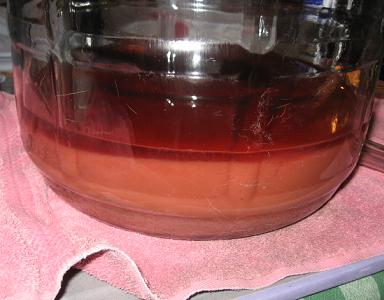
After giving the pectic enzyme 12 hours to do its job (and also allowing the sulphur from the Campden tablets to dissipate somewhat), you can stir in the yeast. After a day or two, the mix will be very bubbly, which pushes the fruit up to the top of the bucket. It will smell a little like wine but look pretty gross. Like this.

Every day, preferably twice a day, you will need to stir the floating fruit back into the liquid. This allows the yeast to keep working on it. Being exposed to air away from the yeast, like the fruit on the top, can give other bacteria a chance to get to work on it. Periodic stirring allows the yeast to colonize and defend every bit of the fruit. Yeast is very good at keeping bad bacteria out of its domain. In a week or so, when the fermentation has slowed down a bit, I will pull out the bag of fruit. Usually I just let it drain and toss the contents. This time, since there was so much fruit, I will press as much liquid out of the must as possible. As it is, I had almost a liter of water-sugar syrup which didn't fit into the bucket to begin with, then I pulled out two liters of juice to avoid overfilling my bucket. Even adding that back in after pulling out the fruit, I will probably be left with less than 5 gallons of liquid to put in the carboy. The difference can be made up with plain water or wine.

I'll post an update when I transfer this batch into the carboy. After that, it's mainly waiting.


Monday, July 25, 2011

Harvest Monday July 25

This was a hectic week. Harvests happened, but not many pictures were taken. The most substantial product of the yard was this SUV on Sunday morning. You can read more about it in detail here. The story involves one parked SUV, one truck with a sleeping driver, and an innocent mailbox. No one was seriously injured (apparently not even the driver, though I imagine he'll be bruised).
One of the two container-grown potato plants got too hot/dry and died. I did salvage about half a pound of tiny new potatoes from it, though. I also picked 3 lb, 14 oz of squash and 2 and a half pounds of tomatoes. You can see those, at least, below, along with farmers market peaches, destined to become a sweet and spicy barbecue sauce.
That brings my totals to

2 lb 14 oz greens
60 lb oranges
13.5 oz kumquats
13 lb cherries
14.5 oz radish pods
8 oz peas
6 lb 12 oz tomatoes
10 lb 2 oz squash
14 oz garlic
4 lb 1 oz new potatoes
2 oz herbs
2.5 oz onions
1 lb 5 oz ornamental plums
16 lb cultivated plums
4 lb elderberries